Have you ever wondered why you can know, completely and rationally, that a fear of flying makes no sense, and still find your body doing something entirely different the moment you think about boarding?
Almost everybody who comes to me about flying has had the statistics explained to them already.
Usually more than once, and usually by somebody well meaning.
They know the safety record.
People know roughly how many aircraft are in the air above them.
Nevertheless, if you know a thing is safe and you’re still frightened of it, fear of flying could explain it.
A phobia is a protective response
That’s all it is. It’s a piece of your subconscious doing precisely the job it was built to do, which is to keep you away from something it has decided is dangerous, and it makes that decision based on what has already happened to you rather than on what is statistically likely to happen next.
The difficulty is that the subconscious doesn’t always know the difference between danger and discomfort. Something frightening happened once, and it was filed away, and now anything that resembles it gets treated as the same emergency. These responses are stored as little pieces of software, little programs, and because of where they’re stored they run automatically, without stopping to ask your permission first. Your conscious mind, meanwhile, is upstairs reciting air safety figures to itself and wondering why nobody’s listening.
So a phobia isn’t a weakness, and it certainly isn’t a character flaw. It’s an old instruction that has never been updated, still being carried out with complete loyalty by a part of you that believes it’s helping. Which, in its own way, it is.
It’s rarely about just one thing
The original experience had conditions attached to it, a particular set of circumstances that were present when it happened. And it’s those conditions the subconscious is watching for, rather than the specific object you’ve come to give the fear its name from. So the response fires in places that appear, on the face of it, to have nothing whatsoever to do with each other, and because they don’t seem connected, nobody connects them.
Somebody comes to me about a fear of flying, and then it turns out that lifts are difficult too, or that they always sit at the end of a row in the cinema, or that a particular meeting room at work has been quietly avoided for years. None of that gets mentioned at the start, because none of it seems relevant. It’s usually the thing that costs the most that brings a person through the door, and everything else has simply been arranged around.
Then the thinking gets hold of it
Which is where most of the damage is done, and it’s the part people almost never mention when they first sit down.
Once the mind knows something is coming, it does not wait for the day itself. Moreover, the fear of flying can feel anticipatory, rising weeks before any event. The thought then pulls the story forward, making it heavier and looping back again.
That’s the loop.
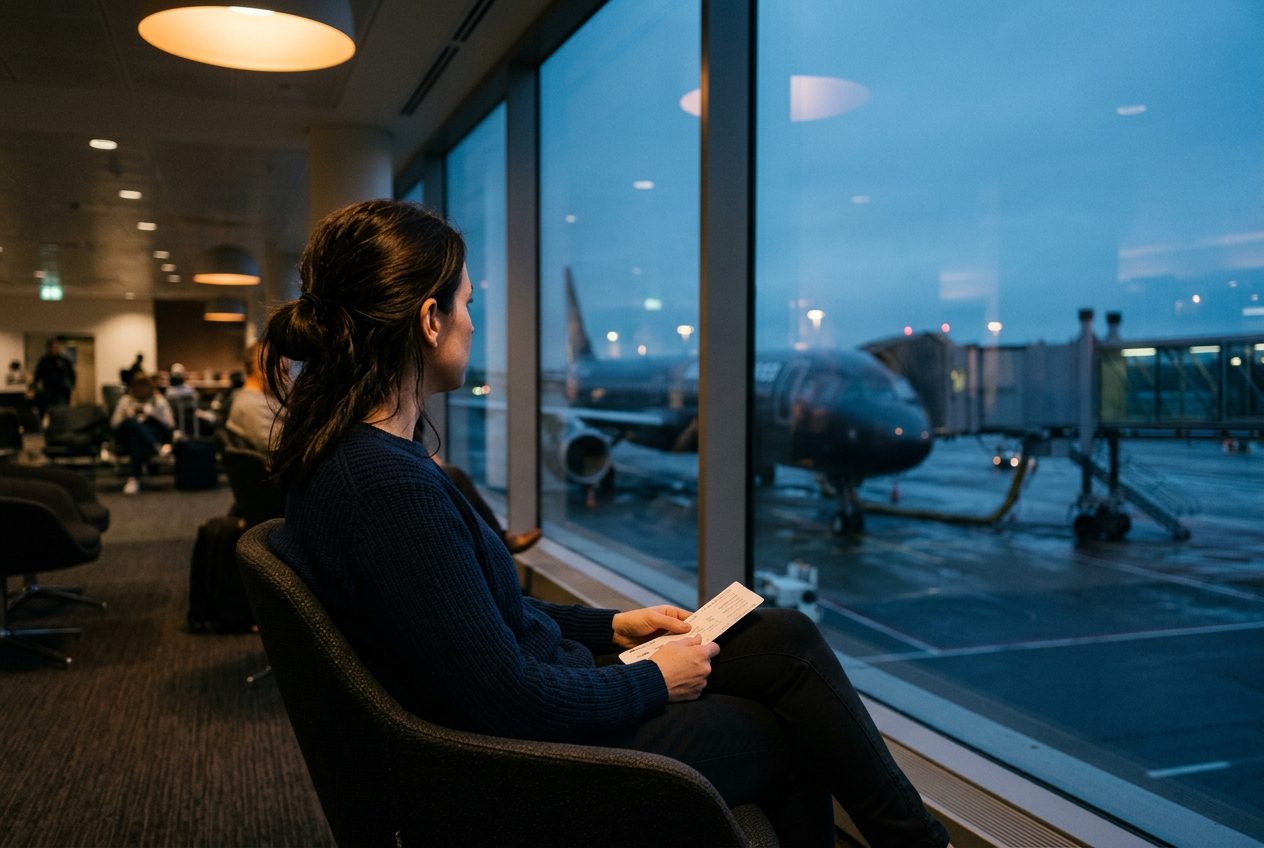
By the time somebody is actually standing at the gate, they have already flown that flight several hundred times in their head, and every single one of those was worse than the real one. Anticipation is where the suffering lives. The three weeks before are almost always harder than the three hours in the air.
What that looks like in practice
A woman I worked with hadn’t flown for fifteen years. She’d tried other forms of therapy before she came to me and none of it had really worked, and it had cost her a good deal more than holidays, because she’d been turning down work opportunities that required her to travel.
We did work on the flying itself, that was part of the plan. But flying was only one of the places it was turning up. It had been happening in the office too, and on roller coasters, and it went all the way back to a childhood experience at a theme park. What she actually had was confined spaces, restricted spaces where you can’t simply get up and leave when you want to, and that early experience, along with the story she’d carried about it ever since, is the reason the anxiety was there at all.
Once you go back to where the instruction was written and sever the link between that experience and the story attached to it, the fear goes with it. And alongside that, she had something to use for the thinking, which is the other half of it and the half that had been running for fifteen years.
She used it right up until she boarded. She flew. And she stopped saying no to the work that involved traveling.
“Before having hypnotherapy with Adam, I had suffered with a fear of flying for 15 years. I had tried other forms of therapy before and nothing had really worked. Adam took the time to understand the root cause of my fear and other factors surrounding it.
After around 5 sessions I finally had the confidence to book a flight. Adam gave me listening material to help right up until boarding which I did use and it helped massively. Never did I think I’d ever make it on that first flight but thanks to Adam I finally did it, and for the first time in my adult life I’ve been able to book a holiday. I can’t thank or recommend him enough.” – Charley
Coming back to your senses
Sensory awareness is what loosens the grip of the spiral, and you can try it today without any help from me.
Your feet on the floor. The temperature of the air on your face. What you can hear in the room right now, including the sounds you’d usually filter out. What’s genuinely in front of you at this moment, rather than the film your mind is running about a departure lounge in three weeks’ time.
It sounds far too small a thing for something that has been running for years. It works because the spiral needs your attention to keep turning. Moreover, your attention can only be in one place at a time. Every time you bring it back into your senses, the loop loses its fuel for a moment. Do that often enough and the moments start joining up.
That won’t reach the original cause, and I wouldn’t pretend otherwise. That’s a separate piece of the picture and it’s what the hypnotherapy is for. But it will give you a way to manage your day to day anxious responses, and for most people that alone is a considerable relief after years of having nowhere.
The part of you that built this was trying to look after you, and it has been doing that job faithfully for a very long time without ever being thanked for it. It doesn’t need to be fought. It needs updating, and it needs somebody to go back with you to where the instruction was first written.
Break The Anxiety Loop
The loop is what my workshop takes apart. Teaching, techniques, workbook and audio meditation, so you leave with something you can use rather than something you understand.
£20, 60 minutes, live every Monday at 7pm UK time.