
Letting go is rarely just about the thing itself.
It is not only the job, or the relationship, or the role. It is the identity that wrapped itself around that experience. It is the version of you that formed in response to it. When that ends, something deeper feels exposed.
The Neutral Zone sits behind every real ending, but before we even reach that space, there is a moment of collapse. The realisation that the old self no longer fits. For many people, that feels like failure. It feels like self-betrayal. You invested years into this career. You built a marriage over decades. You shaped your personality around being that person. To let it go can feel like admitting it was wasted.
But nothing is wasted.
In episode 10 of Inner Earth School we spoke about how transitions are not a reflection of your worth on a deeper level. The job did not make you valuable. The relationship did not grant you meaning. Those experiences expressed parts of you, but they were never the source of you.
When an identity dissolves, depression can follow. Not because you are weak, but because orientation has been removed. We anchor ourselves in roles for safety. I am a husband. I am a manager. I am a personal trainer. These labels create continuity. When they disappear, the nervous system reads it as threat.
There is also grief involved, even if no one has died. Letting go of an identity carries a mourning process. You are not only saying goodbye to a situation. You are saying goodbye to your relationship with that version of yourself. The memories. The effort. The meaning you attached to it. That sadness is legitimate.
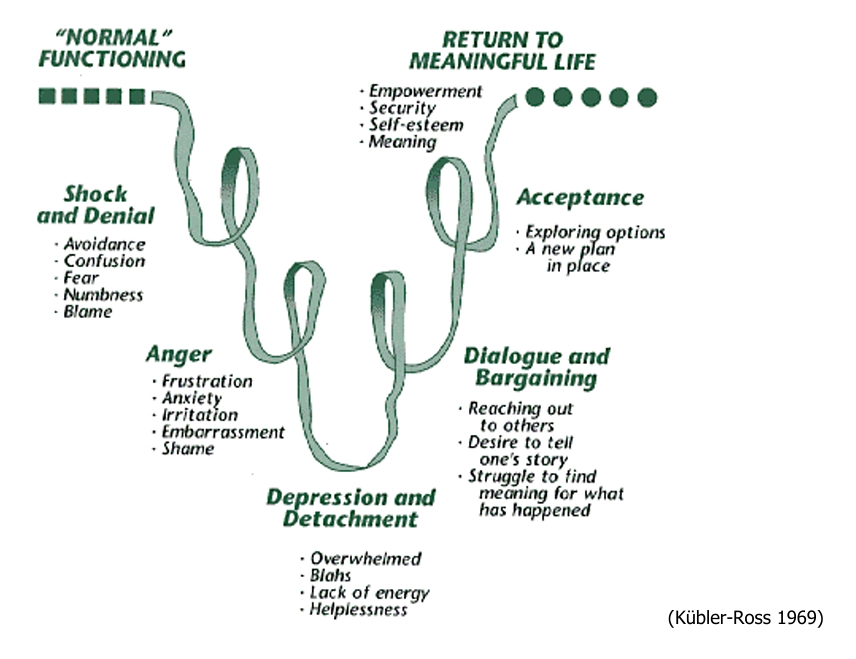
The Kubler Ross Grief Curve offers a useful framework here. Shock, denial, anger, bargaining, depression, acceptance. It is not linear. You do not tick each stage off neatly. You move forward, then dip back. Two steps forward, one step back. Understanding that pattern reduces unnecessary self-judgement. It allows you to see your fluctuation as process rather than regression.
What complicates endings further is the belief that letting go invalidates what came before. If I walk away from this career, was the last fifteen years a mistake. If this relationship ends, was all that time meaningless.
Life accumulates. Everything you have learned compounds. The discipline, the communication skills, the resilience, the emotional maturity. They travel with you. You are not starting from zero. You are starting from experience.
There is an ego element to endings. In episode 10 Roman described it as an ego death, and that is often accurate. The persona you built dissolves. But ego death is not annihilation. It is recalibration. It is the opportunity to see yourself without the costume.
Loving yourself through this phase matters more than pushing yourself through it. As Brené Brown says…
“Owning your story and loving yourself through that process is the bravest thing you will ever do.”
Self-compassion does not mean avoiding responsibility. It means allowing the grief to exist without layering shame on top.
At some point, you will have to put the old suit down before you can pick up the new one. That is simply how transition works. You cannot carry everything forward. But what you learned while wearing it is already integrated.
When the breakdown becomes a breakthrough, you become something else entirely. Not because the pain was necessary in some dramatic sense, but because pressure reveals structure. It exposes what was fragile and what was real.
Endings are not proof that you have failed.
They are proof that you are evolving.

Support for Your Journey
If you are navigating an ending and it feels heavier than expected, you do not need to rush through it.
The Pathfinder journey supports you through endings, the Neutral Zone, and new beginnings with clarity and steadiness.
📞 Book a free 45-minute Pathfinder Discovery Call with Roman and explore where you are in your transition.